

Bookkeeping Services That Bring Clarity
Our outsourced bookkeeping services keep your books accurate and reports clear, so decisions feel easier.
30-minute conversation • No obligation, just clarity

Clean Books. Smarter Decisions.
Accurate Books,
Every Month

Monthly bookkeeping services keep transactions organized, accounts reconciled, and your books accurate and current.
Numbers You
Can Act On

Monthly financial reports show where money goes, what needs attention, and what to do next confidently.
Focus on What Matters

Outsourced bookkeeping keeps support dependable, workloads lighter, and your attention focused on leading your business.







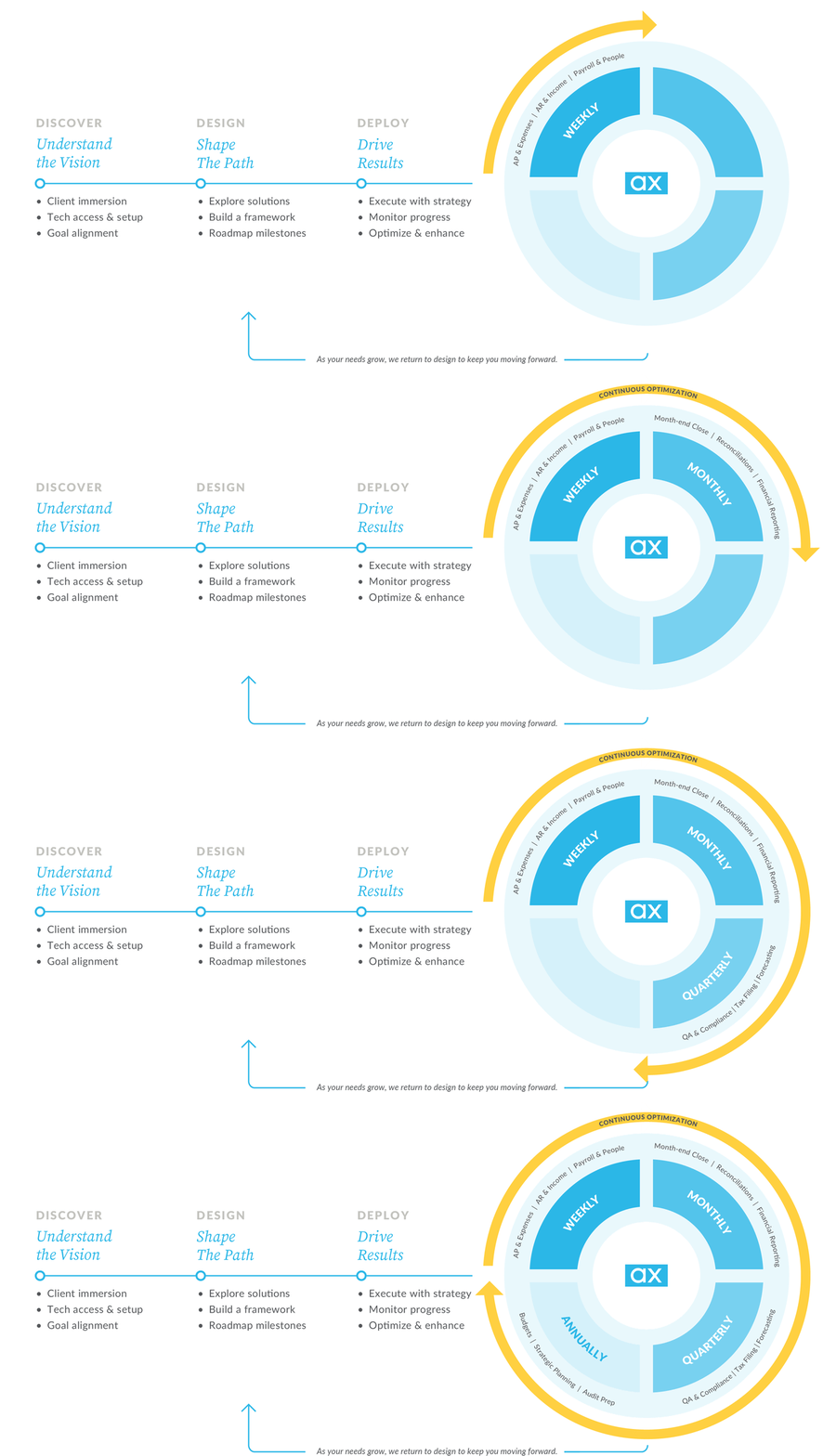

How Accountix Helped Satellite Turn Financial Complexity into Growth
Accountix helped Satellite simplify and understand its financials through reliable bookkeeping support, transforming the business from reactive financial management to more confident, informed decisions.
Bookkeeping Tools & Platforms
Our QuickBooks bookkeeping services fit into your existing tech stack, helping keep financial records organized across payroll, payments, and reporting. Contact us to discuss the tools you use.
-
Accounting Platform
-
Revenue Systems


-
Payroll


-
AP Workflows & Payments


-
Forecasting & Reporting




Learn more about Outsourced Bookkeeping Services…
Bookkeeping Services That Keep Your Books Clean and Decision-Ready
Listen to this section (15 min)
Most owners find out something is wrong with their books in March, sitting across the table from their CPA. By then, the mistake is ten months old, and all you can do is pay for it.
We close your books every month instead, starting at $200 a week, so the number you need is already there when you need it.
Accountix is a Santa Barbara-based outsourced accounting firm providing monthly bookkeeping services for growing businesses and nonprofits across the country. We handle transaction management, account reconciliations, accounts payable and receivable, payroll categorization, and a monthly close with reports delivered on a fixed schedule.
Our online bookkeeping services run entirely in cloud-based systems, including QuickBooks Online, BILL, and Ramp.
Quick Answers
What Are Bookkeeping Services?
Bookkeeping services cover the ongoing recording, categorizing, reconciling, and review of your financial transactions so your books stay accurate, current, and ready to use. A full service handles six core jobs: transaction management, account reconciliations, accounts payable, accounts receivable, payroll categorization, and the monthly close.
Outsourced bookkeeping puts those responsibilities with one team instead of adding another in-house hire. Accountix bookkeeping starts at $200 per week, and 150+ clients nationwide rely on our accounting and finance support.
Top Takeaways
- Bookkeeping covers more than transaction entry. Transactions, reconciliations, AP, AR, payroll categorization, and the monthly close all work together. A provider handling only the first two is doing data entry.
- Fixed pricing makes bookkeeping predictable. We scope the work before it begins, so a busy month does not create an unexpected invoice.
- Accuracy happens at the close. Categorizing transactions all month accomplishes nothing if nobody reconciles accounts, reviews balances, and checks the financial statements before reporting.
- Messy books are fixable. Catch-up bookkeeping follows a repeatable process built around source documents, reconciliations, account cleanup, and bringing each period forward accurately.
- Know when you have outgrown bookkeeping. Once you need budgets, forecasting, stronger controls, or controller-level oversight, you need outsourced accounting. Paying for bookkeeping and expecting oversight is the mismatch we see most.
What Do Outsourced Bookkeeping Services Include?
Good bookkeeping keeps an accurate record of the money moving through your business, then turns that record into financial statements you can actually use.
Here is what an Accountix bookkeeping engagement covers:
- Transaction management. We record and categorize income, expenses, bills, and deposits so your day-to-day books stay current.
- Account reconciliations. We match bank and credit card accounts against your records every month, which is how a discrepancy gets caught in week one instead of month nine.
- Accounts payable. We enter bills and schedule vendor payments in BILL and Ramp, so vendors get paid on time and you keep the terms you negotiated.
- Accounts receivable. We track open invoices and record payments, so you can see what customers owe and what has actually been collected.
- Payroll categorization. We enter payroll data and coordinate with Gusto, ADP, Rippling, or QuickBooks so labor costs land in the right accounts. Full payroll management is available at the outsourced accounting level.
- Monthly close and reporting. We reconcile accounts, review entries, close the books, and deliver financial reports on a consistent schedule.
One important note on scope: bookkeeping creates the accurate financial foundation your CPA and leadership team need, but it does not replace either one. We coordinate directly with your CPA or tax professional so they work from organized, current records instead of rebuilding the books at tax time.
How Much Do Bookkeeping Services Cost?
Accountix bookkeeping starts at $200 per week.
That starting tier is designed for businesses under $2 million in annual revenue and often includes monthly bookkeeping, monthly reporting, and quarterly financial review meetings. Larger or more complex organizations move up: outsourced accounting starts at $350 per week, and a full accounting department starts at $1,000 per week. See the full tiers on our pricing page.
Four factors shape the final scope:
- Transaction volume. A consultancy processing 40 transactions a month is a different engagement from a restaurant processing thousands.
- Complexity. Multiple entities, restricted grants, job costing, inventory, or complicated revenue flows each add real work.
- Cadence. Monthly bookkeeping is standard. Some clients need weekly support. A few need daily support.
- Cleanup backlog. If your books need catch-up work before ongoing bookkeeping can begin, we scope that separately.
We price fixed, never hourly. You get the number before the work starts, and it holds when the month gets busy.
If you are comparing bookkeeping firms, ask what is included in the quoted price and what would trigger a change in scope. That tells you more than the starting rate does.
Wondering whether your overall finance spending is in a normal range? Our guide to what a finance function actually costs breaks down finance spending by company size, from smaller businesses that may spend several percent of revenue to mature organizations operating closer to 1%.
What Does a Real Month-End Close Look Like?
A month-end close turns a month of bookkeeping activity into financial statements you can trust.
Without a consistent close, the books can look complete inside the accounting software while still containing unreconciled accounts, incorrect classifications, missing entries, or balances that do not make sense.
Reviewing the financial statements is where most providers stop short. Profit and loss statements get the attention because they are easy to read, but a miscategorized transaction usually surfaces on the balance sheet first.
Our Month-End Close Checklist for Small Businesses walks through the complete process, the common mistakes to look for, and the five steps involved in closing the books properly.
What If My Books Are Already Behind?
Being behind is common, and it does not mean you need to start over.
Catch-up bookkeeping starts by finding out how far back the problems go. From there, we reconcile accounts to source documents, correct inconsistent entries, clean up the chart of accounts where needed, and work forward period by period until the books are current.
The issues we see most often include:
- Bank or credit card accounts that were never fully reconciled
- Personal and business expenses mixed together
- Duplicate or inconsistent accounts
- Transactions sitting uncategorized for months
- A chart of accounts that grew by accident rather than by design
None of that is unusual, and all of it is fixable.
Our QuickBooks Chart of Accounts guide explains how a cleaner account structure makes financial reporting easier to understand and maintain as the business grows.
When Do You Need More Than Bookkeeping?
Bookkeeping keeps your financial records current and accurate. It does not build budgets, forecast cash, or design the controls that keep money from walking out the door. Once you start asking forward-looking questions, you have outgrown it.
You have crossed that line when:
- You are making hiring, pricing, or expansion decisions and your reports only tell you what already happened
- One person controls too many parts of a financial process without independent review
- A lender, board, investor, or grantor expects budget-to-actual reporting
- You need accrual financial statements rather than basic cash-basis reporting
- Leadership needs budgets or cash flow forecasts
If you need accounting and bookkeeping services under one roof, that is the point to step up to outsourced accounting services, which adds stronger processes, budgeting and forecasting, internal controls advisory, and controller-level review on top of everything bookkeeping already covers.
Moving up does not have to be disruptive. Our guide to moving from in-house bookkeeping to outsourced accounting covers the handoff, the responsibility matrix, and what to ask a firm before you commit.
If your questions are strategic, like pricing, margins, cash flow, or growth plans, fractional CFO services add CFO-level guidance on top of accurate books.
Plenty of clients start with bookkeeping and stay there for years, and that is exactly right. We would rather tell you that on an intro call than sell you a tier you do not need yet.
"In ten years of cleaning up other people's books, I have seldom found a business that failed at bookkeeping because the software was wrong. It failed because nobody reconciled the balance sheet, and small errors compounded quietly for eleven months."
Van Haas, AccountixSolutions.com
Essential Bookkeeping Resources
These resources show what good recordkeeping, financial reporting, controls, and data security look like, so you can judge any bookkeeping provider against them.
1. Know Which Business Records the IRS Expects You to Keep
IRS Publication 583 explains federal business recordkeeping requirements and shows how to keep an organized recordkeeping system. Use it to decide what records your bookkeeping process needs to maintain and how long to keep them.
Source: Internal Revenue Service, Publication 583, Starting a Business and Keeping Records
2. Get a Plain-English Introduction to Business Finances
The U.S. Small Business Administration covers financial statements, accounting methods, cash flow, and basic financial management. It is a good starting point if you want to understand what your bookkeeper or accountant is producing.
Source: U.S. Small Business Administration, Manage Your Finances
3. Understand Payroll Recordkeeping Requirements
The U.S. Department of Labor outlines the payroll records employers must keep under the Fair Labor Standards Act, including employee information and wage records. Payroll is where bookkeeping and compliance overlap most.
Source: U.S. Department of Labor, Fact Sheet #21: Recordkeeping Requirements under the FLSA
4. Learn How the Financial Statements Work Together
The U.S. Securities and Exchange Commission gives a beginner-friendly overview of the balance sheet, income statement, and cash flow statement. No single statement tells the whole story, and knowing how they connect makes it easier to judge whether your monthly reporting is complete.
Source: U.S. Securities and Exchange Commission, Beginners' Guide to Financial Statements
5. Use Free Financial Templates and Small Business Guidance
SCORE offers financial statement templates and free guidance for small business owners. It is useful when you are setting up financial processes, improving reporting, or preparing to work with a bookkeeper or accountant.
Source: SCORE, Financial Statements
6. Understand How a Provider Protects Your Financial Data
The Federal Trade Commission's cybersecurity guidance for small businesses covers access management, vendor risk, and data protection. Use it as your checklist when you ask a bookkeeping provider how your financial information will be stored and protected.
Source: Federal Trade Commission, Cybersecurity for Small Business
Supporting Statistics
Hiring a Bookkeeper In-House Comes With More Than Salary
The U.S. Bureau of Labor Statistics reports:
- Median annual wage for bookkeeping, accounting, and auditing clerks was $50,670 in May 2025
- Employment is projected to decline 6% from 2025 to 2035
- About 144,100 openings per year are projected over the decade, largely because workers leave the occupation or the labor force
That median is salary alone, before employer payroll taxes, benefits, recruiting, software, management time, or covering the seat when someone leaves. It is why an outsourced bookkeeping team pencils out for most small businesses, and why we build engagements around a team rather than one person. A resignation on our side never becomes your problem.
Small Businesses Are Operating Under Significant Cost Pressure
The Federal Reserve Banks' 2026 Report on Employer Firms found:
- 77% of small employer firms reported rising costs of goods, services, or wages, tariff-related cost increases, or both
- Reaching customers and growing sales was the most commonly reported operational challenge
We see this in the books before owners see it in the bank account. Businesses that close monthly spot margin changes in month two instead of discovering at tax time that costs have moved faster than revenue.
Source: Federal Reserve Banks, 2026 Report on Employer Firms
Final Thoughts
Bookkeeping is not just transaction entry. It is a recurring process built around accurate records, reconciliations, and a dependable monthly close. The goal is not to make the accounting software look organized. It is to give you financial information you can trust.
Now the opinion, which not everyone in our profession will enjoy:
- Most "bad bookkeeping" is really a missing close. The transactions usually got entered. Nobody reconciled the balance sheet, so a misclassified loan payment sat in the wrong account for most of the year. When we take over messy books, the fix is rarely heroic. It is doing the monthly close on a schedule.
- Cheap bookkeeping is the most expensive kind. A low-cost service that categorizes transactions and never reconciles hands you books that look finished and are not. You pay twice: once for the service, again for the cleanup.
- Software helps, but judgment does not automate. QuickBooks and AI-assisted categorization keep improving, and we use them daily. Neither can tell you a transaction was coded to the wrong job, because the entry looks perfectly valid.
- Ask providers what they will not do. Any firm can list services. The ones worth hiring will tell you plainly where bookkeeping stops and what it costs to go further.
Clean books are not the finish line. The win is walking into a decision already knowing the answer.
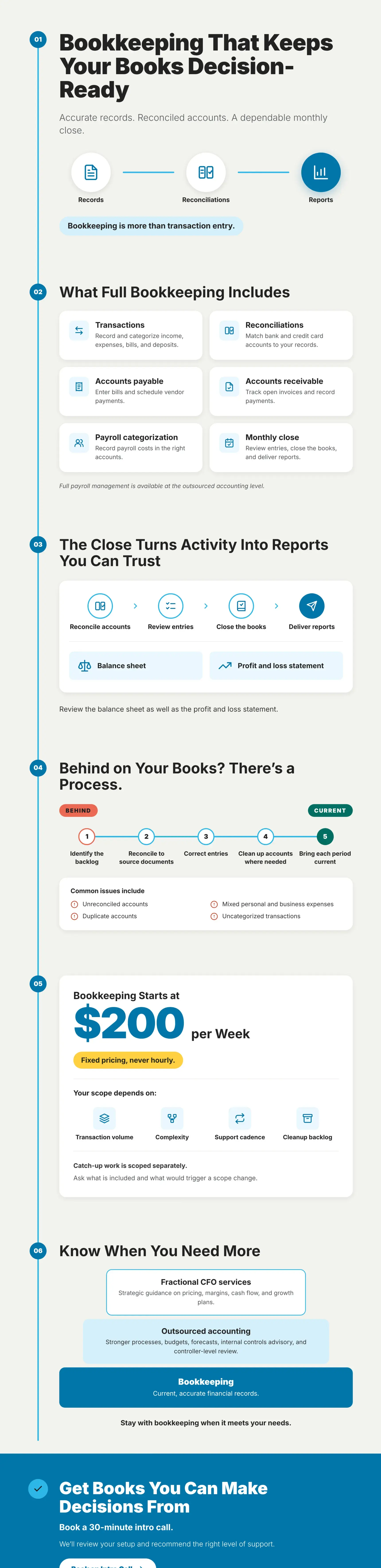
Open the infographic full size
Get Books You Can Actually Make Decisions From
Book a 30-minute intro call and we will review your current setup, explain what it would take to get your books clean and current, and recommend the right level of support. Bookkeeping starts at $200 per week.
Book an Intro Call · Call 1-800-757-0510