

Fractional CFO Services for Nonprofits
Executive financial oversight to help your nonprofit scale its mission with confidence and total board transparency.
30-minute conversation • No obligation, just clarity

Budgeting & Forecasting

Dynamic roadmaps that align spending with mission goals and donor expectations.
Program & Cost Insights

Analysis into program efficiency to see exactly where every dollar makes the most impact.
Cash Flow Modeling

Predictive modeling to manage donor cycles and ensure liquidity year-round.








Nonprofit Outsourced CFO Services Include
Financial leadership that helps your organization plan ahead and make mission-aligned decisions.
Executive Decision Support
Turn financial results into clear, actionable next steps for leadership.
Board and Funder Narratives
Clear storytelling that translates data for boards, funders, and stakeholders.
Budget Leadership and Reforecasting
Build budgets, monitor performance, and adjust as your year evolves.
Forecasting and Scenarios
Multi-scenario forecasting tied directly to your funding and program plans.
Cash Flow Modeling
Grant and program-level cash forecasting to eliminate financial surprises.
KPI Dashboards
Visual mission and financial KPIs in leadership-friendly, scannable formats.
Program Economics
Analysis of cost drivers, sustainability, and program mix decisions.
Controls and Risk Strategy
Strengthen governance, approvals, and your overall financial risk posture.
Audit Strategy Support
Prepare leadership and boards for audit issues, requirements, and outcomes.
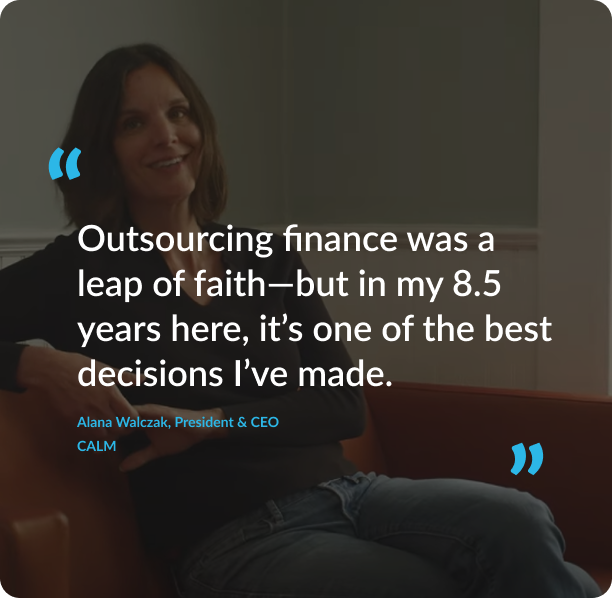
How CALM Transformed Its Financial Operations with Accountix
CALM partnered with Accountix for nonprofit fractional CFO leadership, modernized systems, faster receivables, simplified budgeting, and clearer audit-ready reporting, giving the team confidence to focus on its mission.
Nonprofit Financial Tools & Platforms
Leverage financial technology for real-time visibility, advanced forecasting, and the data-driven insights. We work with many platforms beyond those shown. Contact us to discuss your tech stack.
-
QuickBooks for Nonprofits

-
Donor Management




-
AP Workflow & Payments


-
Forecasting & Reporting




Learn more about Fractional CFO Services for Nonprofits…
Nonprofit Fractional CFO Services
Listen to this section (21 min)
Nonprofit fractional CFO services give 501(c)(3) organizations part-time executive financial leadership without the cost of a full-time CFO. The work can include forecasting, reserve and cash planning, grant and program budgeting, and board-level financial reporting.
What you typically get:
- Monthly forecasts and a cash runway view tied to grant timing
- Board and finance committee reporting with context, not just numbers
- Operating reserve targets and a documented approach to liquidity planning
- Program and grant budgets built on supportable cost allocations
- Audit and Form 990 readiness handled throughout the year instead of every spring
Who it's for: nonprofits managing increasingly complex funding, organizations taking on federal awards, teams between finance leaders, and boards that need more forward-looking financial information.
Who it isn't for: organizations whose books are not yet reconciled or reliable. Fix the accounting foundation first, because forecasting is only as useful as the numbers behind it.
Top Takeaways
- A bookkeeper records the past while a fractional CFO models the future. If your reports tell you what happened but not what to do next, you've found the gap.
- The trigger is usually a question, not a budget size. Once the board starts asking questions your financials cannot answer, you may have outgrown compliance-only support.
- Reserve and liquidity planning have become more important. FASB ASU 2016-14 requires nonprofits issuing GAAP financial statements to disclose how they manage liquidity and what financial assets are available for general expenditures within one year.
- Controller work usually comes before CFO work. Clean, timely books first, then forecasting. Doing it in the other order wastes money.
- Fractional means proportional, not partial. You get CFO-level thinking and guidance, sized to what your organization needs right now.
What Is a Fractional CFO for a Nonprofit?
A nonprofit fractional CFO provides part-time executive financial leadership without the cost or commitment of a full-time CFO. The role goes beyond closing the books and reporting what already happened. A fractional CFO helps leadership understand what the numbers mean for the months and years ahead.
For nonprofits, that often includes grant forecasting, cash flow planning, reserve strategy, program budgeting, scenario modeling, and financial reporting for the board and finance committee.
The difference is direction. A bookkeeper records transactions. A controller makes sure the financials are accurate, reconciled, and ready to report. A fractional CFO uses those numbers to help leadership decide what to do next.
Nonprofit finance also brings complexities a for-profit CFO may not regularly face:
- Revenue often comes with restrictions, so not every dollar can support general operations
- Grant periods rarely align perfectly with fiscal years, which means cash timing and revenue recognition can tell different stories
- Expenses must be allocated across program, management, and fundraising using a methodology that can stand up to funder and auditor scrutiny
- Financial reporting often goes to volunteer board members who need context and interpretation, not just financial statements
When Does Your Nonprofit Need CFO-Level Help?
The need for nonprofit CFO services usually shows up as a question leadership cannot confidently answer from the monthly financials.
Common signs include:
- The board wants to know what happens if a major grant is not renewed
- Leadership needs a reliable cash forecast tied to grant and donor timing
- You are considering a new program and need to understand the financial impact before committing
- Reserves are declining and there is no defined plan for rebuilding them
- A multi-year grant requires more detailed forecasting and spend-down planning
- Your finance committee needs clearer reporting and forward-looking analysis
- You are preparing for significant growth, a leadership transition, or a new funding model
- Federal funding is increasing the complexity of reporting, controls, and audit preparation
Budget size alone does not determine whether you need a fractional CFO. The better question is whether your organization is making decisions that its existing financial reporting cannot adequately support.
There is also a point where CFO support is too early.
If books are not reconciled, the monthly close is consistently late, or fund balances cannot be trusted, the first priority is usually controller-level accounting support. Forecasting is only useful when the underlying financial data is reliable.
Our nonprofit accounting services page maps out where each level of support fits. The right level of service depends on the problem you are trying to solve.
How a Nonprofit Fractional CFO Forecasts Grant and Restricted Revenue
Nonprofit forecasting gets difficult when the funding calendar and the operating calendar do not line up.
A grant may cover 12 months while your fiscal year ends halfway through the award. A reimbursement-based contract may recognize revenue while cash arrives weeks later. Restricted funding may support a program but remain unavailable for other operating expenses.
A nonprofit fractional CFO brings those moving pieces into one forward-looking financial model.
That can include:
- Forecasting each award against its actual grant period rather than spreading revenue evenly across the year
- Modeling expected grant renewals separately from funding that has already been committed
- Tracking when restricted funds are expected to become available for their intended purpose
- Connecting program spending to grant budgets and funding timelines
- Identifying reimbursement gaps that could create short-term cash pressure
- Stress-testing the budget when major grants, contracts, or fundraising assumptions change
The goal is not simply to produce a more detailed spreadsheet. It is to give leadership a clear view of what is committed, what remains uncertain, and how both affect future cash needs.
Grant timing can also make healthy organizations look financially weaker or stronger than they really are. Accountix has seen nonprofits enter board meetings showing what appeared to be a significant deficit when the underlying issue was the timing of revenue and program expenses across reporting periods.
Our case study on the “deficit” that wasn't a deficit shows why fund tracking and financial interpretation have to work together.
Reserve Planning and Nonprofit Liquidity
A reserve target becomes much more useful when leadership knows what the target represents, when reserves can be used, and how they will be rebuilt.
Simply saying the organization should maintain "three to six months of reserves" leaves an important question unanswered. Three to six months of what?
For some nonprofits, the appropriate base may be total operating expenses. For others, unrestricted operating expenses provide a more meaningful measure. The calculation should reflect how the organization actually operates and how much financial flexibility it needs.
Fractional CFO support can help leadership:
- Define an operating reserve target
- Model how long available cash can support operations
- Separate donor-restricted funds from resources available for general use
- Account for board-designated reserves in liquidity planning
- Establish triggers for using and replenishing reserves
- Connect the reserve strategy to annual budgeting and cash flow forecasting
Liquidity also has a financial reporting component.
FASB ASU 2016-14 requires nonprofits issuing GAAP financial statements to provide qualitative information about how they manage liquid resources and quantitative information about financial assets available to meet general expenditures within one year. Availability can be affected by donor restrictions, contractual or legal limits, and internal limits established by governing board decisions.
Your reserve strategy, cash forecast, and financial statement disclosures should tell a consistent story.
If your leadership team needs a refresher on restricted, unrestricted, and board-designated funds, our GAAP basics for nonprofits provides a plain-English overview.
Board-Ready Financial Reporting Your Finance Committee Can Actually Use
A board packet should do more than summarize what happened last month.
Board members need enough context to understand where the organization stands, what has changed, what could happen next, and whether leadership needs a decision from them.
Effective nonprofit financial reporting typically brings together:
- Budget-to-actual performance
- Updated forecasts
- Cash and liquidity outlook
- Grant and program performance
- Key financial risks
- Reserve levels and trends
- Clear explanations for significant variances
- Decisions or issues that require board attention
That narrative matters.
Board members are often experienced leaders, but they may not work in accounting or finance. Handing them a statement of activities without interpretation forces each person to decide what the numbers mean on their own.
A fractional CFO helps translate the financials into the questions a board actually needs to discuss.
What changed? Why did it change? Is it temporary or structural? What happens if the current trend continues? What decision needs to be made now?
"In ten years of nonprofit engagements, I've never seen a board crisis that started as a strategy problem. It always starts as a reporting problem nobody escalated. By the time an organization calls us, the numbers have usually been telling the story for three or four quarters. The issue is that nobody in the room could read them out loud."
Van Haas, CEO, Accountix
Accountix can prepare the reporting, develop the financial narrative, and participate in board or finance committee meetings when additional CFO-level support is useful.
We explore that relationship in more detail in how outsourced accounting helps nonprofit boards.
Fractional CFO Services for Fundraising and Development Planning
Development and finance work from different systems, but they ultimately have to agree on the same revenue picture.
A fractional CFO can help connect fundraising plans to the organization's budget and cash forecast by:
- Building revenue forecasts from the development pipeline rather than simply increasing last year's fundraising number
- Modeling when pledges and grants are expected to turn into cash
- Connecting campaign and program plans to the expenses required to deliver them
- Building grant budgets with supportable cost and allocation assumptions
- Stress-testing new programs or fundraising initiatives before the organization commits resources
- Reconciling donor CRM information with the general ledger
That last step matters more than it may seem.
When the development report and financial statements show different numbers in the same board meeting, leadership has to stop discussing strategy and start figuring out which number is right.
Bringing development and finance into the same forecast gives leadership one version of the financial story.
Fractional CFO vs. Fractional Controller for Nonprofits
Fractional CFO and fractional controller services solve different problems.
A fractional controller focuses primarily on whether the numbers are accurate and the accounting process is working properly.
Controller-level work may include:
- Monthly close management
- Account reconciliations
- Fund and grant tracking
- Cost allocation methodology
- Financial statement preparation
- Audit schedules and documentation
- Accounting controls and processes
A fractional CFO focuses on what leadership should do with those numbers.
CFO-level work may include:
- Forecasting and scenario planning
- Cash and liquidity strategy
- Reserve planning
- Program economics
- Executive decision support
- Board and finance committee reporting
- Long-range financial planning
Our guidance is that most organizations need the controller-level work solved before CFO-level support delivers its full value.
If the close is late and the numbers are unreliable, fix the accounting foundation first. If the books are clean but leadership still cannot answer forward-looking financial questions, that is where fractional CFO support becomes valuable.
Because Accountix supports both levels of the finance function, we can help determine which one you actually need, even when the answer costs you less.
What Does a Nonprofit Fractional CFO Cost?
The cost of a nonprofit fractional CFO depends on the complexity of the organization, the level of financial leadership required, the systems involved, and how frequently the CFO needs to work with leadership or the board.
Accountix engagements start at $350 per week, with final pricing based on the scope of support.
Organizations may need a lighter cadence for monthly forecasting and executive review, while others need deeper support around budgeting, grants, board meetings, financial systems, or major organizational changes.
The value of the fractional model is that the level of support can be sized to the organization.
For comparison, the U.S. Bureau of Labor Statistics reported a median annual wage of $166,570 for financial managers in May 2025, before benefits, payroll taxes, recruiting costs, and other expenses associated with a full-time hire.
Many nonprofits do not need a full-time executive working 40 hours a week. They need CFO-level judgment at the moments when financial decisions are being made.
Fractional support provides access to that expertise without building an executive finance position before the organization actually needs one.
Key Nonprofit Finance Statistics
The financial environment nonprofits are operating in helps explain why forecasting, liquidity planning, and board-level financial leadership have become increasingly important.
More Than Half of Surveyed Nonprofits Had Three Months of Cash or Less
Nonprofit Finance Fund's 2025 State of the Nonprofit Sector Survey included responses from 2,206 organizations about their financial and operational experience in 2024.
Among respondents:
- 52% had three months or less of cash on hand
- 18% had one month or less of cash on hand
- 36% ended 2024 with an operating deficit, the highest percentage reported in ten years of the survey
- 84% of organizations receiving government funding expected cuts to that funding
Limited liquidity leaves less room for unexpected funding delays, program changes, or rising expenses. A rolling cash forecast gives leadership more time to identify those risks and decide how to respond.
Source: Nonprofit Finance Fund, 2025 State of the Nonprofit Sector Survey
Most Nonprofits Reported Difficulty Covering Their Full Costs
Independent Sector's 2025 Health of the U.S. Nonprofit Sector report found that:
- 81% of surveyed organizations struggled to raise enough funding to cover all of their costs
- 68% expected demand for services to increase in 2026
- Only 31% said they were expanding the number of people they serve
- 33% reported disruptions to government funding during the first four to six months of 2025
When demand grows faster than the resources available to meet it, budgeting becomes more than an annual exercise. Leadership needs to understand which programs are financially sustainable, where funding gaps may develop, and what changes the organization can absorb.
Source: Independent Sector, 2025 Health of the U.S. Nonprofit Sector
A Full-Time Finance Executive Is a Significant Commitment
The U.S. Bureau of Labor Statistics reported that:
- The median annual wage for financial managers was $166,570 in May 2025
- The lowest 10% earned less than $94,310
- The highest 10% earned more than $323,270
- Employment for financial managers is projected to grow 10% from 2025 to 2035
Those figures are not nonprofit CFO salary benchmarks specifically, but they provide useful context for the broader market cost of senior financial talent.
For organizations that need strategic financial leadership without enough ongoing work to justify a full-time executive, a fractional model can provide a more proportional level of support.
Source: U.S. Bureau of Labor Statistics, Financial Managers
Helpful Nonprofit Finance Resources
The right financial decisions start with reliable information. These resources provide additional guidance on several of the accounting, governance, funding, and reporting issues nonprofit leaders commonly encounter.
IRS Form 990 Resources and Tools
The IRS Form 990 hub explains filing requirements, forms, schedules, and other information tax-exempt organizations need when preparing their annual return.
A fractional CFO does not replace your tax preparer, but financial reporting throughout the year should make the Form 990 process easier rather than creating a separate scramble at filing time.
Source: Internal Revenue Service, Form 990 Resources and Tools
Operating Reserves for Nonprofits
The National Council of Nonprofits provides guidance on establishing and managing operating reserves, including questions boards should consider when creating a reserve policy.
It is a helpful starting point for organizations trying to move from a general goal of "building reserves" to a defined policy for how much to maintain, when reserves may be used, and how they will be replenished.
Source: National Council of Nonprofits, Operating Reserves for Nonprofits
FASB ASU 2016-14
FASB Accounting Standards Update 2016-14 includes the liquidity and availability disclosure requirements that apply to nonprofit financial statements prepared under GAAP.
The standard requires qualitative information about how the organization manages liquid resources and quantitative information about financial assets available to meet general expenditures within one year.
Source: Financial Accounting Standards Board, ASU 2016-14
Board Roles and Financial Oversight
BoardSource provides guidance on nonprofit board responsibilities and the roles directors and officers play in governance and financial oversight.
Understanding those responsibilities can help leadership decide what financial information the board needs, what belongs with the finance committee, and where outside financial expertise may be useful.
Source: BoardSource, Board Member Roles and Responsibilities
Federal Single Audit Requirements
Organizations receiving federal awards should understand when Single Audit requirements apply.
Under 2 CFR 200.501, a non-Federal entity that expends $1 million or more in federal awards during its fiscal year generally must have a Single Audit or, when applicable, a program-specific audit.
Organizations approaching that threshold benefit from planning before the audit requirement arrives, especially around grant tracking, documentation, internal controls, and the Schedule of Expenditures of Federal Awards.
Source: Electronic Code of Federal Regulations, 2 CFR 200.501
Cash Flow Management for Nonprofits
Propel Nonprofits offers practical guidance on nonprofit cash flow, including why revenue timing can create financial pressure even when an organization has a balanced annual budget.
For organizations funded through grants, reimbursement contracts, pledges, or seasonal fundraising, understanding the timing of cash can be just as important as understanding annual revenue.
Source: Propel Nonprofits, Cash Flow Management
Federal Grant Post-Award Requirements
Grants.gov explains what happens after a federal award is made, including implementation, reporting, monitoring, and closeout.
Those requirements can introduce additional financial reporting, documentation, and compliance responsibilities that should be incorporated into the organization's finance calendar from the beginning of the award.
Source: Grants.gov, Post Award Phase

Open the infographic full size
Get the Financial Leadership Your Mission Deserves
Your financial reporting should do more than document the past. It should help your leadership team and board make better decisions about what comes next.
Accountix fractional CFO services give nonprofits access to forecasting, cash and reserve planning, board-ready reporting, and senior financial guidance without requiring a full-time executive hire.